
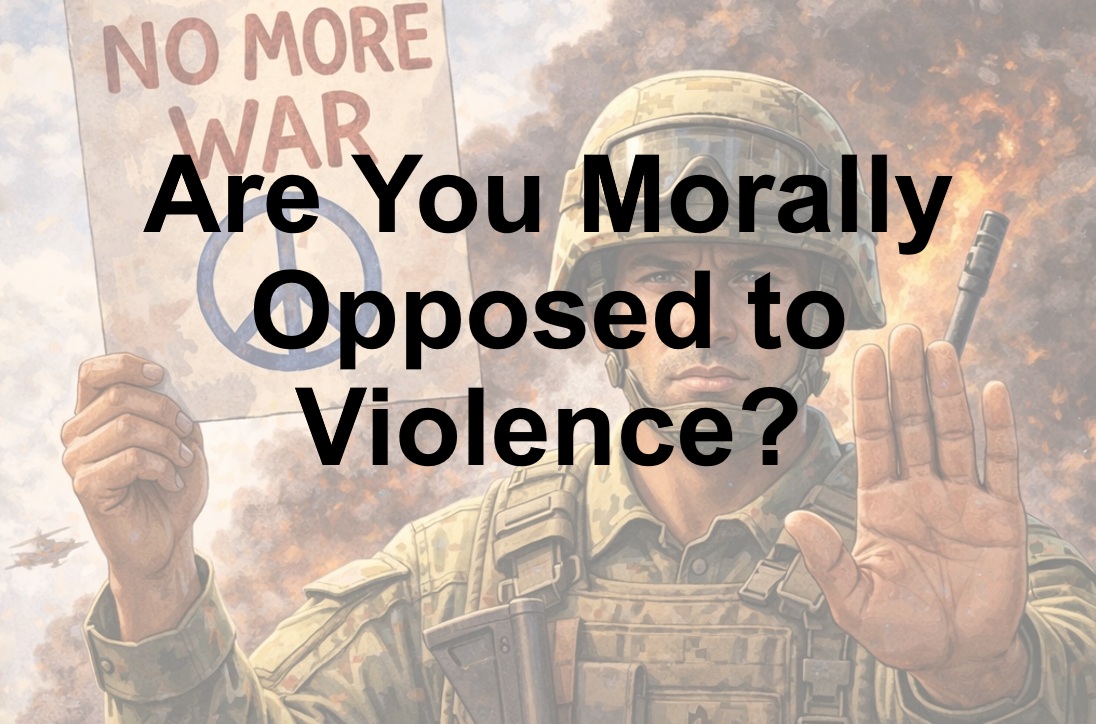
“Some men are morally opposed to violence. They are protected by men who are not.” -Nick Lavery
This quote came up in one of my social feeds and, as so many thoughtful posts do, made me stop and think. I don’t know Nick Lavery personally, but before I used his quote, out of respect from one military veteran to another, I reached out via the social platform. I shared with him a very basic idea of the thoughts his quote had inspired, my intention to write on it and received his near immediate agreement and encouragement. God bless military veterans and those who serve.
 On the surface, the statement is obvious. It’s true. Some men are opposed to acts of violence, even on their own behalf, because they feel that violence is morally wrong. They are protected by men (and women) who are willing to commit acts of violence in self-defense and in defense of others. And then my brain went down the rabbit hole… Just because these men and women are willing to commit acts of violence, does that mean they have no moral objection to it?
We don’t live in the time of “Conscientious objectors.” I mean, sure, there are people who would probably avoid a draft claiming to be, but they haven’t had to stand up or be put on the spot. And I’ve long believed that a pacifist is only a pacifist until they are convinced by circumstance and experience otherwise. If you hit that pacifist in the face and knock them down a few times, each time apologizing and helping them up, eventually they will either defend themselves and fight back, thereby throwing off pacifism as a belief structure, or they will literally surrender their humanity to you by refusing to get back up and accepting anything else you decide to do to them while they’re down.
 The thing is, those of us who “aren’t morally opposed to violence,” are strongly opposed to such cruel behavior. We’d never punish that pacifist with continued attacks in an attempt to change their outlook. More than likely our outlook would be, “You do you, pal.” And if someone else tried to victimize that pacifist in such a way, we would stand and defend them.
That pacifist is the ultimate sheep. He will do anything to avoid conflict even to the extent of remaining silent when he disagrees with a statement or situation. We who are willing to commit acts of violence in a righteous and justified fashion are the sheepdogs. But just because we will commit acts of violence, does it follow that we have no moral objection to it?
 I think not. Sure, we tend to believe that some people deserve to have their asses handed to them – or worse. There was a time in my career where I happened to serve a warrant on a serial-rapist, and let’s just say that I wasn’t real upset when he resisted arrest. I didn’t feel bad at all helping him into those handcuffs and I wasn’t going to shed a tear for any injury to him that resulted from that fight. But if he had peacefully and without any resistance obeyed my commands, would he have ended up in those handcuffs completely unharmed? Yes. Why? Because my morals are such that I couldn’t, in good conscience, simply whip his butt for my own gratification and entertainment value. You see, I am morally opposed to unjustified violence – and every warrior I know feels pretty much the same way.
And therein lies the rub. When anyone pursues a career wherein they have to commit the occasional act of violence, with full righteousness and justification, does it follow that they will feel no guilt or doubt afterward? I assure you the answer is no. Every warrior I know has, at some time or another, wondered if their actions were the best choice; if another option existed, or they’ve felt guilt-by-extension. What is that?
 Long ago I met an officer who had been in a shooting. The man he shot had just robbed a commercial establishment and this officer had the poor timing (or great timing, depending on your outlook) to be walking in as the perpetrator was walking out. The officer wasn’t going in as a response to the crime. He had not been dispatched. He was the junior partner in a two-man car and had been sent in by his senior officer to get lunch. Four hotdogs coming up. Two with ketchup and onions, two with ketchup, mustard and relish. He never got the hotdogs. As he was going in, the robber was coming out and when the robber saw the uniformed officer, he fired three shots at the officer from a snubnose .38. The officer fired two rounds back. That he could share experience tells you the officer emerged victorious to tell the tale.
The officer, now retired, shared with me that in retrospect, thinking over the incident as he had done so many times, he felt no guilt then and he feels no guilt now. The criminal removed the options, and the officer certainly had no moral objection to self-defense or capturing those who violated the law, especially if they did it in a violent fashion. However, later the officer learned that the perpetrator was married and had two young children. The officer did feel guilty then. Guilt-by-extension. Why? Because the fact she was a widow and the two kids were then fatherless was his responsibility: a direct result of his actions.
 The officer had no moral objection to violence but felt the weight of the immorality of leaving a wife and kids without their husband and father. We could debate endlessly if they are actually better off because of the type of man he was, but the debate will never change what happened.
Many of us who take an oath and wear a uniform, whether it’s military or law enforcement, accept the reality that we may have to visit harm upon others in the course of our duties. We are either morally okay with that, or we have to learn to deal with how it feels after the fact. We step up. We do what we have to. Some of us learn early on that we’re in fact not okay with committing those acts of violence and remove ourselves from whatever profession we thought we could do. Some of us experience the violence of duty, realize we’re not as okay with it as we thought we’d be, and we talk to our peers, our priests, counselors, etc. We find a way to deal with the doubts and make sure to minimize future hesitation that might result.
 We have to perform as if we have no moral objection to violence but rest assured when I tell you: I’ve never met a warrior that preferred violence. Every one that I’ve ever met and gotten to know would prefer peace. But knowing that we will face evil doers and knowing that our duty will require us to commit acts of violence, we learn, we train and we condition ourselves to be efficient at those acts of violence.
That is not a lack of moral objection to violence. That’s honoring our commitment and recognizing reality and dealing with the morality of righteous and justified violence and accepting the ever-growing weight of how we’ll feel afterward.
We are not harmless men. Harmless men are incapable of violence; they have no weapons, no heart and no training. We are peaceful men. We have the heart, the weapons and the training and we discipline ourselves into using all of that only as justified and necessary for the protection of those we serve. We prefer peace but make no mistake: we are willing and capable of going to war when called upon to do so by duty or circumstance.


